


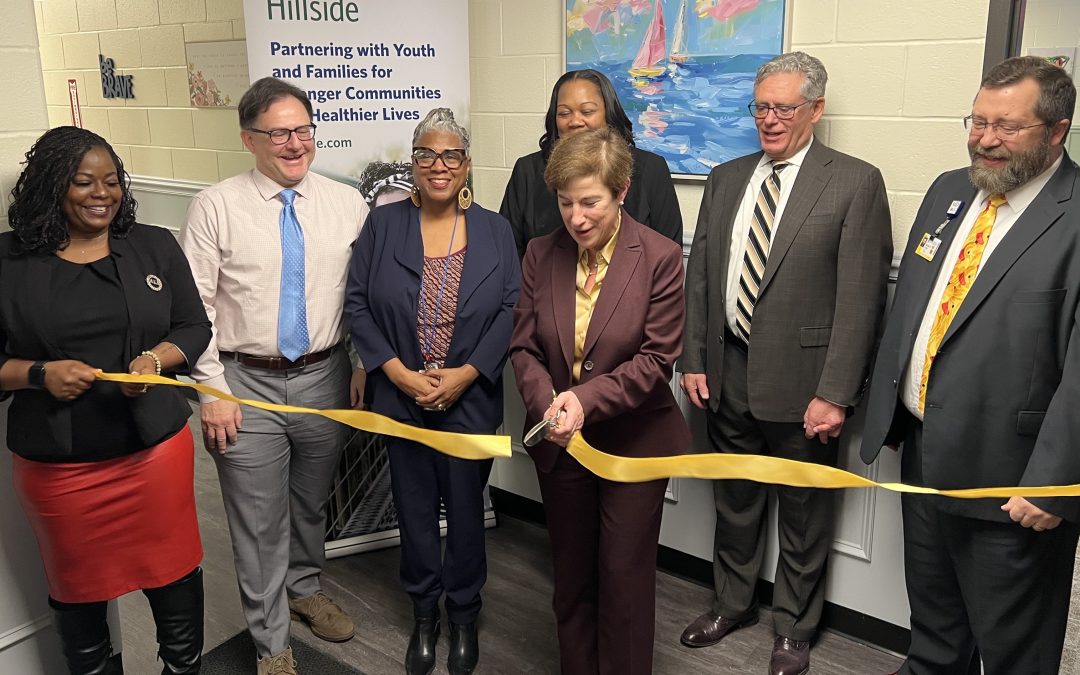
A January 21 ribbon-cutting ceremony marked the official launch of Hillside’s Next Steps Critical Time Transition Program (CTTP), a new collaboration between Hillside and the University of Rochester Medical Center, Rochester Regional Health and other regional hospitals.
Hillside is the first agency in the state to admit youth into the innovative program that provides enhanced care-management services for youth with complex needs, as well as transitional residential beds as needed, as the youth journey from hospital stays back to their homes and families.
In New York State and around the country, young people with mental health challenges and other complex needs frequently experience discharge delays from hospital-based care due to insufficient community services that can appropriately support a safe transition to their homes and families.
The CTTP model, funded by the New York State Office of Mental Health (OMH), is designed to address that critical lack of access to out-of-hospital services. Hillside’s Next Steps CTTP is comprised of community-based services provided by a multidisciplinary Critical Time Intervention (CTI) team; and a Transitional Residential Setting (TRS) where eligible youth (ages 11-17 years) can receive 24/7 support for up to 120 days. The CTI team has begun providing services to youth, and the TRS program will open soon.
“For too long, a critical gap in their care pathways has prevented vulnerable youth from leaving behind the hospital settings they no longer need to stay healthy and safe,” said Maria Cristalli, President and CEO of Hillside. “The Critical Time Transition Program is an innovative model that helps to fill that gap—and Hillside is excited to partner with our regional hospitals to provide Next Steps CTTP services to youth and families in need.”
The ceremony included additional observations by partners and special guests including:
- Thalia Wright, Commissioner of the Monroe County Department of Human Services, emphasized the importance of partnerships in supporting the complex needs of youth facing mental health challenges. “Transitional moments, when handled well, can change the trajectory of a young person’s life,” she said. “Through this collaboration, we are building the bridge between hospital care and community-based supports for youth who need stability, structure, and the time to heal. This program represents a shared commitment to reduce unnecessary hospital stays, to support families who’ve been navigating incredibly difficult circumstances, and to build solutions that are rooted in care, dignity, and accountability.”
- Dr. Shirley Green, Commissioner of the City of Rochester Department of Recreation and Human Services, called the program “a much-needed solution” for children and families. “It is critical that our youth feel safe and supported when experiencing a crisis,” she added, and Next Steps “will ensure that those crucial moments between hospitalization and release are monitored with therapy and support provided as seamlessly, continuously, and productively as possible.”
- Dr. Michael Scharf, Chief of the Golisano Children’s Hospital Division of Child and Adolescent Psychiatry, said that long-term hospital boarding can exacerbate the mental health conditions of youth in care. He praised the Next Steps program and URMC’s partnership with Hillside as an example of the “connection and collaboration over time” that aims to relieve those issues by helping youth transition back to their families and communities. “This program moves us one step closer to that goal, and that’s the work that I’m really proud to be part of,” he added.
- Riley Owens, a Hillside Youth Peer Advocate, shared how her personal experiences with mental health challenges allow her to form critical connections with youth served by the Next Steps team. “Throughout my own journey, I’ve come to understand how isolating mental health concerns can be. I wish I had someone who knew what I was going through that could also support me,” Owens said. “I’m happy to use my lived experience to support self-advocacy, skill building, goal setting, and encouragement” for youth in the Next Steps program.
Hillside is one of a handful of agencies statewide to have been authorized by NYS OMH to launch a CTTP model in its community. The Rochester-based Next Steps will be headquartered at Hillside’s Monroe Campus, in a onetime residential cottage that underwent significant renovations to support the program’s community-based and 24/7 residential treatment components. The renovations were supported in part by a grant from the Greater Rochester Health Foundation and the Rochester Area Community Foundation.
A second Hillside Next Steps CTTP is being planned to launch in Erie County, leveraging initial partnerships between Hillside and that region’s Golisano Children’s Hospital of Buffalo (formerly Oishei Children’s Hospital) and Erie County Medical Center.
“These programs would not be possible without ongoing strategic collaborations with our hospital partners, the County of Monroe, our generous donors and especially the state Office of Mental Health,” Cristalli added. “We’re incredibly grateful for the opportunity to bring this program to the communities we serve.”
Community support keeps #HillsideStrong! Make a difference by making a gift today.